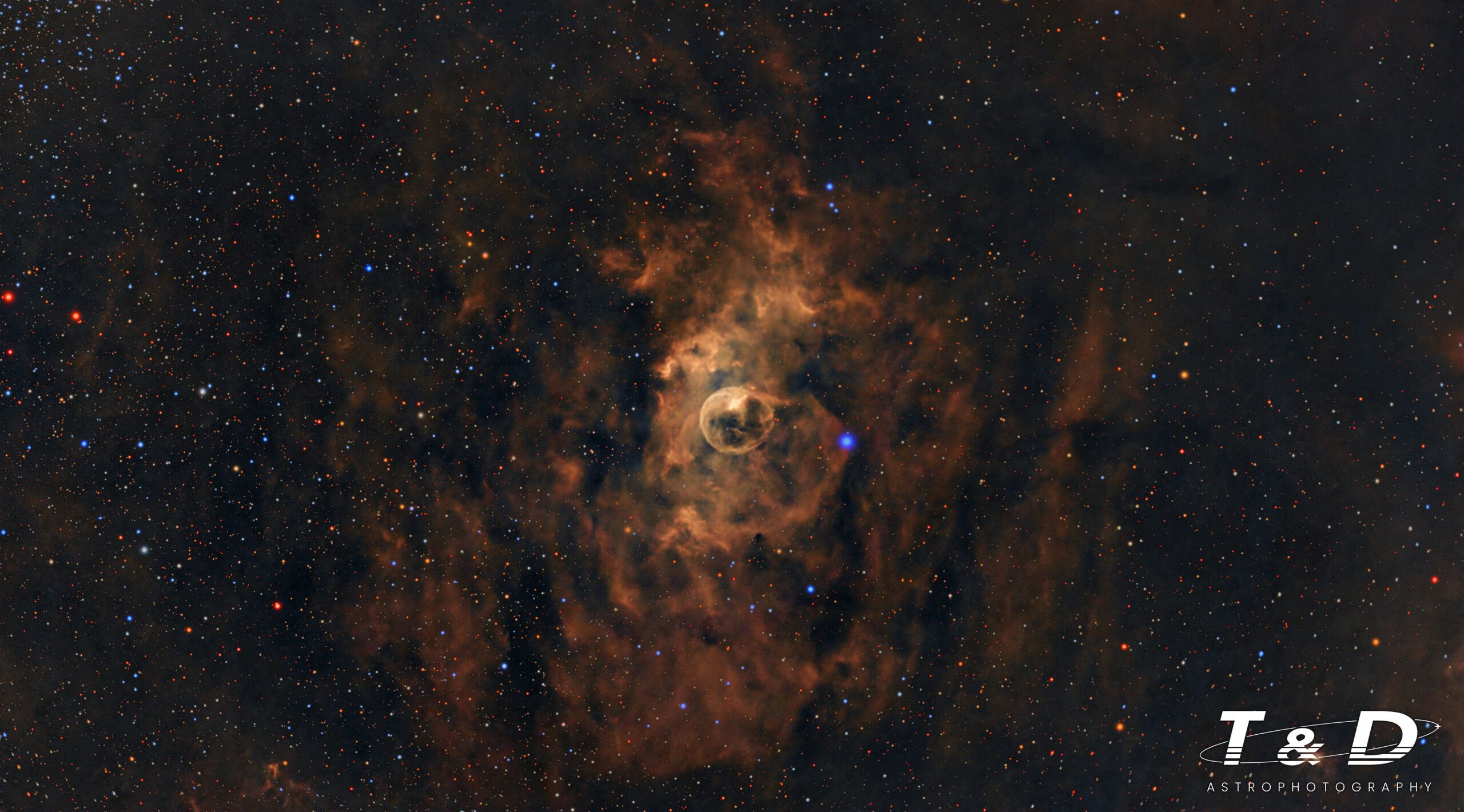
$ The Bubble Nebula
NGC 7635
About 7,000–8,000 light-years away in Cassiopeia, a massive young star is blowing a bubble into space. The star, BD+60°2522, is an O-type giant dozens of times the mass of our Sun. Its stellar wind races outward at roughly 1,800 km/s and sweeps the surrounding gas into a glowing shell about 7 light-years across.
The bubble isn’t perfectly centered on the star. One side is pushing into a denser molecular cloud, so the shell is lopsided, and the star sits off to one side. The surrounding hydrogen glows red, and oxygen emission gives the bubble its blue-teal edge.
And all of this came from Dubrava, in the middle of Zagreb, under city skies. A triband filter cuts through the light pollution, and thousands of short exposures on an alt-az mount beat the field rotation. Patience did the rest.
5½ hours of photons, one 15-second slice at a time, for one small bubble. Worth every clear night this week.
- Posted
- Location
- Zagreb, Croatia (Bortle 8 zone)
- Integration
- 1340 × 15 s (~5.5 hours) over one week
- Equipment
- Celestron Origin Mark II, Antlia Triband RGB Ultra II, alt-az mount